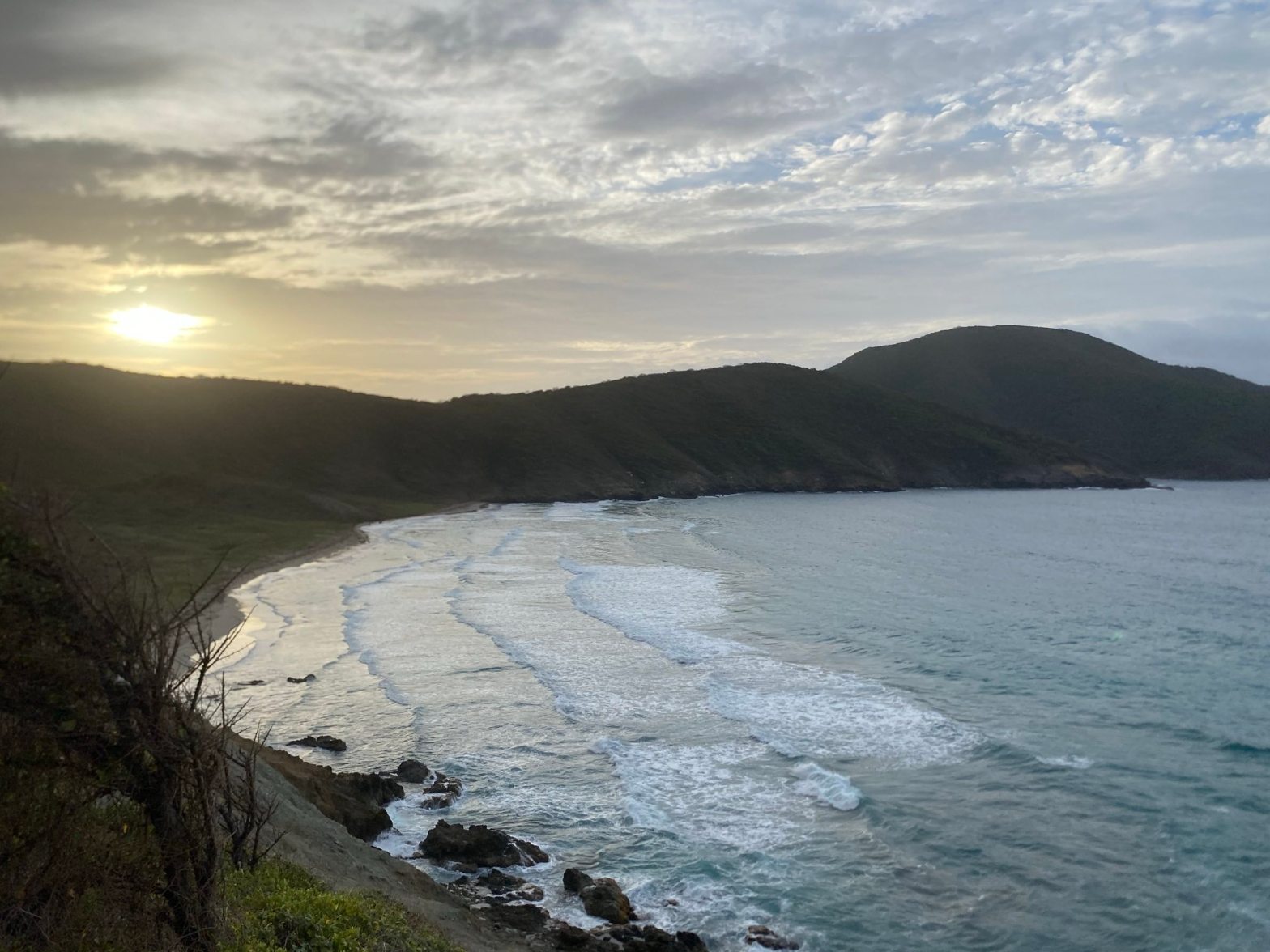
“Un paraíso de humedad y silencio”: A paradise of humidity and silence. That’s the way Colombia’s most beloved writer, Gabriel García Márquez, described the jungles of the Sierra Nevada de Santa Marta, a coastal mountain range in the Colombian northeast. On my first day walking through the Arhuaco community of Gunmaku, it certainly felt that way to me. We arrived just as school started at seven in the morning, following a four-am-wakeup and a three-hour drive up rocky, unpaved roads. The Sierra embraced us as we drove through her, a close press of green leaf and taut grey sky. At the top of the path, she unfolded us into a dirt parking lot with the morning spilling out in rolling mountain, banana palm, fallen mango.
My DukeEngage team, led by Dr. Dalia Patiño-Echeverri and Dr. Miguel Rojas-Sotelo, arrived in the Sierra Nevada de Santa Marta on the heels of one of Colombia’s most groundbreaking edicts. The Sistema Educativo Indígena Propio (SEIP) grants Colombia’s indigenous communities—over a hundred—complete authority over the education of their youth: their course content, school structure, and educational pedagogy. The bill, which had been pushed for tirelessly by indigenous leaders and various indigenous organizations (such as ONIC, the Organizacion Nacional Indigena de Colombia) throughout the country, finally went through on the year of Santa Marta’s five-hundredth birthday: that is, five hundred years of colonization, of contact. Now, indigenous communities all over the country are grappling with the future that educational freedom promises them.
During our first three weeks, our mission as volunteers was not to act: instead, we partook in the experience of sitting in the back row, watching and listening. We heard from indigenous leaders working in the nation’s capital of Bogota, organized and hosted a three-day workshop for leaders and teachers in indigenous schools to share their thoughts and experiences, and sat in on classes at several schools to understand teachers’ pedagogical philosophies and their struggles in the classroom.
First morning at Gunmaku, a large Arhuaco school a few hours from Gabo’s hometown of Aracataca. The Sierra unfolds like Gabo’s paradise around me. I am led through the school of Gunmaku to a classroom building further down a hill, where the preschool students are learning numbers and letters. Their ages range from five to twelve years old: many families live far from even the closest schools, and the sacrifice getting to Gunmaku means that children often wait several years before leaving their homes to start school. On my first day, I sit on a stool in the corner of the classroom and take notes: how many indigenous students, how many “campesino” students (children of farmers), how many have pencils, how many are active and interested. The answer is all of them: they count bottlecaps aloud to themselves, copy the ISBN numbers on the back of their notebooks, read their favorite letters from the dusty posters on the wall. I’m an intrusion, a bumpy-nosed stranger with a creamy new notepad. I do my best to blend in, look only at the teacher, to model learning behavior.
Halfway through the morning, I glance up from my meticulous and isolated notes and find our professor standing in front of me. “¿Qué han hecho?” he asks me: what have I been working on with the students? I feel caught out for a moment. I’ve been actively trying not to work with the students yet, to be quiet and distant.
In Bogotá, during our first week in Colombia, the DukeEngage team had the wonderful opportunity to visit the Ministry of Education. We spent an afternoon in conversation with Dr. Abadio Green, current advisor in the Colombian Ministry of Education and leader of the Guna people. He shared with us everything from the roles of the sun and the moon in creation stories to his experiences being pulled out of a traditional mamo’s training—the highly specialized education that young men chosen to become spiritual leaders in their communities undergo—and sent to a Colombian school. Boys training to be mamos often spend years without speaking. When I asked him about that experience, he told me “el silencio fue mi mejor pedagogo, mi mejor aliado”: silence was my best tutor, my best ally. From listening to silence as a child, he learned to listen to la madre, to Mother Nature.
I puzzled over this answer during the entirety of my trip. It was the grade schoolers who taught me what it meant.
F— is in preschool. She is nine years old. She comes up to my rib, with straight brown hair that runs chestnut in the light, and a big Disney t-shirt she wears as a dress when it’s time for “aseo,” the school-wide cleanup after classes end. Her smile is warm and infectious, universally loved. F— can weave mochilas, and she likes math. On our first day, we sit through lunch hour together, doing addition after addition. She’s shy of speaking to me, and her Spanish isn’t good yet, but after lunch she takes my hand wordlessly and leads me through the village of Gunmaku.
Y— comes with us too. She’s also nine, but she’s in second grade. She has a face as sweet as agua panela and curling hair that settles around her face in little black ringlets. She takes me to the seat where her grandfather used to sit before he passed and tells me proudly: “esta es la silla de mi abuelo.” When I thank her, she takes my other hand and tells a story about one of the mango trees in the village: there was a snake in it once, and the mamo said nobody should eat the fruit off it anymore. She likes taking pictures with a digicam my sister lent me for the trip and asks F— to pose with the mochila she’s knitting.
I meet I— next week. She’s eight and she’s in first grade. She wears a pigtail for her bangs, a wispy braid, and a smile that means mischief. She’s bold, insistent on taking up space and making her voice heard, but prone to moments of insecurity. After we work through some tearful frustration during an art activity, she sidles up to me after lunch and kicks around the reading space with me as the sky opens up in one of this summer’s heavy afternoon showers. I learn about her sick mother, and then her sick brother. The sky dries up, and so does her story: we spend the next thirty minutes playing hide-and-seek.
T— finds me in week three. I’m working on putting together a library for the elementary schoolers, annotating each one with a summary, a vocabulary list, and a series of reading questions. She has big eyes and sharp cheekbones in a face framed by shoulder-length hair, and soon she’s with me through every long morning I spend in the reading-space sorting through the books. Sometimes we talk—she tells me stories about the jaguar her uncles had to scare off and about her late older brother—and sometimes we don’t: she reads with me quietly and helps me cut up tape for the library project.
We walk around the school in the hot, heavy sun. The fallen mangoes make the air sweet and sour, and somebody’s donkey manages to yank its post from the ground. We laugh as it trots around the parking lot, dragging rope and post behind it. Afternoons with F—, Y—, I—, T—, with X—, C—, A—, Z—, M— and G— fill me with hope: I love their stories and their sums, their intelligence and excitement.
We traveled to other schools, too. Gunmaku was large and well-established, but there were plenty of satellite schools—what administrators called “sedes”—farther into the Sierra. At the school of Mulkuaguinaka, we met Juliet, the sole teacher of a single-classroom school serving Kogui and Wiwa students near the coast. We brought her tables and chairs; Mulkuaguinaka was three months old and still not officially recognized by the Colombian government, so all its resources were personal contributions from the community. Most of Mulkuaguinaka’s students were young, and its remote location meant that many of them had little familiarity in speaking Spanish. Instead, we learned to sing “Head, Shoulders, Knees, and Toes” in Kogui and Wiwa languages from the student’s mothers and aunts, who often accompanied them in their lessons.
R— is my star at Mulkuaguinaka. She’s not sure how old she is—her father says around nine—and she doesn’t speak any Spanish, so we smile and gesture at each other over my notebook. R— is trying to learn to read. We practice writing letters together. We say “ma, me, mi, mo, mu” together until we break into giggles. Every day at school entails a three-hour walk over multiple rivers and a day off of work for her father, who is a widower.
On our very last weekday in Colombia, we visited the school of Teyku. Led by the intrepid Rubiela, Teyku was a Kogui school situated in the Parque Nacional de Tayrona, an area sacred to indigenous communities of the Sierra and beloved by tourists from all over the world. We had spent about four weeks visiting Teyku, where we’d learned about the Friday-morning cultural classes the children spent learning skills like stool-carving and mochila-weaving from their parents and where we’d been shown the stone steps left by the ancient Tayrona people before colonization fractured them into the communities known today: the Kogui, the Arhuaco, the Wiwa, and the Kankuamo.
I spend the morning playing with the second and third graders, who don’t have teachers today. We toss around the mandarin lemons that grow on the carefully cultivated trees around the school. We play catch, then soccer, then we race. When we get tired, I pull out my notebook and ask everyone for their names. To demonstrate, I draw a stick figure and my name next to it: not everyone can write, but I want everyone to have a chance to sign the notebook if they want to. We gather a small crowd and manage to get through twelve signatures before recess is over, pointing and miming through our mutually choppy Spanish: Sophia (me), M—, A—, Y—, L—, S—, S—, N—, S—, C—, A—, S—.
By the end of our trip, our grand listening experiment had yielded several projects: two personalized documentaries, one for Teyku and one for Gunmaku; an audiovisual message from mamos in various communities warning against climate change; lesson plans for teachers across several schools; individualized ICFES (Colombian SAT equivalent) tutoring for graduating students; and my pet project, a library of over ninety books, complete with a personalized library guide and teaching resources for professors at the school of Gunmaku. But I’d learned so much more. From each mamo who welcomed us and gave us permission to enter and work with their community, I learned about respecting la madre, our Mother Nature, in both thought and action. From each professor who shared their thoughts and feelings with us, I learned about structural and systemic obstacles in the Colombian education system, and the courageous effort it takes to overtake them. From each student I spent walking with, sitting with, playing with, eating with, and reading with, I learned how to listen to silence.
Silence is an active verb. To engage in silence is to listen for what the world around you hopes to tell you; it’s to look for what you can learn from others and what you can give to others; it’s to find connection without ego or the necessity of spoken word. To listen to silence is to give the world room to show you community and your role in it. Silence is revelation; it’s storytelling; it’s the catalyst for change. The grade schoolers at Gunmaku, Mulkuaguinaka, and Teyku knew silence, and they were kind enough to share it with me. I know they will do great things.
On my flight home, I opened up my notebook to relive the signatures and the notes that I’d collected over the summer. Imagine my surprise when I found three new ones.


This article was written as a reflection on a volunteering experience through DukeEngage, a program of Duke University. To preserve their privacy, the names of children have been partially redacted.
 Sophia Fratta
Sophia:
Thank you for taking me with you on this wonderful excursion in a part of the world that now takes on a whole new face for me!
Beautifully written, tender, informative and enriching!
What a wonderful opportunity to research your Columbian heritage!
You didn’t miss a beat! This is exciting!
Jacqui Damackine
LikeLike